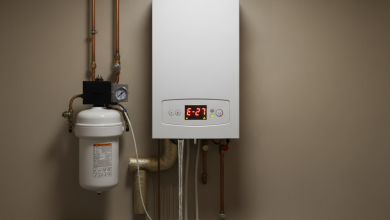
Over time, your central heating system—pipes, radiators, and boiler—becomes contaminated with a mix of rust (known as magnetite), dirt, and limescale. This mixture hardens into a thick, sludgy sediment.
This sludge is the silent enemy of your heating system, leading to cold spots, noisy components, and eventually, a costly boiler breakdown. The solution? A thorough deep clean, typically through powerflushing and ongoing protection via chemical dosing.
While you can buy DIY kits, powerflushing a boiler should always be left to a qualified professional. The job requires specialist equipment (a high-flow, low-pressure pump), professional-grade chemicals, and the expertise to safely handle the system and dispose of the corrosive wastewater. Attempting a DIY powerflush can damage your system, void your boiler’s warranty, and even be dangerous if you don’t correctly isolate the electrical and gas components.
Part 1: Powerflushing—the deep clean
What is powerflushing a boiler?
Powerflushing is an intensive cleaning procedure designed to remove the accumulated boiler sludge removal (rust, scale, and debris) from your entire central heating system.
- Connection: A specialist powerflushing machine (a high-flow, low-pressure pump) is temporarily connected to your central heating system, usually at the boiler or circulation pump.
- Chemical dosing: A powerful cleaning chemical, often a descaler and a sludge remover, is added to the system water.
- High-flow circulation: The machine circulates this chemically-treated water at a high velocity (but low pressure, to protect your pipes) to forcibly dislodge and suspend the sludge. The direction of the flow is often reversed to ensure maximum agitation.
- Individual flush: Each radiator is typically isolated and flushed individually to ensure stubborn blockages are cleared. A heating engineer may use a tool, like a rubber mallet, to gently tap radiators and break up hardened sediment.
- Removal: The dirty, contaminated water is then removed from the system and safely disposed of.
- Rinse and neutralise: The system is flushed multiple times with clean water to neutralise the cleaning chemicals and ensure all residue is gone.
Is powerflushing necessary?
In many cases, yes. A powerflush is highly recommended and often necessary if your system exhibits any of the following signs of sludge build-up:
| Sign | Implication |
| Cold spots on radiators | The bottom of the radiator is cold, even when the heating is on, because sludge is blocking the hot water flow. |
| Boiler kettling or loud noises | The boiler is struggling to heat the sludge-coated heat exchanger, causing overheating and a loud rumbling sound. |
| Slow warm-up times | The entire system takes much longer than normal to heat up. |
| Dirty/discoloured water | The water that comes out when you bleed a radiator is dark, rusty, or sludgy. |
| Repeated pump or valve failure | Sludge is seizing up internal boiler components. |
| New boiler installation | A system must be thoroughly cleaned before a new boiler is installed to prevent immediate damage and to maintain the warranty. |
Part 2: Powerflush cost
The cost of a powerflush varies significantly based on the size of your property, the number of radiators, and your location (London and the South East are generally more expensive).
As a general guide, the average costs for a professional powerflush (including chemicals and labour, but sometimes excluding a magnetic filter) are:
| Number of radiators | Property size | Average cost range (UK) |
| 6-8 radiators | 2-Bed House | £350 – £500 |
| 8-10 radiators | 3-Bed House | £450 – £650 |
| 10-15 radiators | 4-Bed House | £600 – £850 |
Factors that increase the price:
- System condition: Heavily sludged or blocked systems take much longer.
- System type: Open-vented systems (with a tank in the loft) can be slightly more complex.
- Add-ons: Installation of a magnetic filter (highly recommended) usually adds £100–£150.
Part 3: Chemical dosing and prevention
Once your system is clean, the key is to keep it that way. This is achieved through chemically dosing your central heating—the addition of protective fluids to the water.
What is central heating inhibitor fluid?
Central heating inhibitor fluid is a chemical solution added to the clean water in your heating system. Its primary functions are:
- Corrosion prevention: It creates a protective layer on the internal surfaces of the metal components (radiators, pipes, heat exchanger) to prevent the formation of rust (magnetite sludge).
- Limescale control: It conditions the water to reduce the formation of hard limescale deposits, which are particularly damaging to the boiler’s heat exchanger.
- pH nalancing: It helps maintain the water’s pH balance, reducing the corrosive properties of the water.
Inhibitor fluid should be added after any system flush, new boiler installation, or anytime the system has been drained. It should also be checked and topped up as part of your annual boiler service.
Powerflushing is an investment, but the costs are quickly recouped through lower energy bills and avoiding the need for expensive repairs, ultimately extending the lifespan of your boiler by many years.
With Rated People, you have the power to get it done. Find a trusted, local tradesperson today.